Washington · AZ Weekly Post
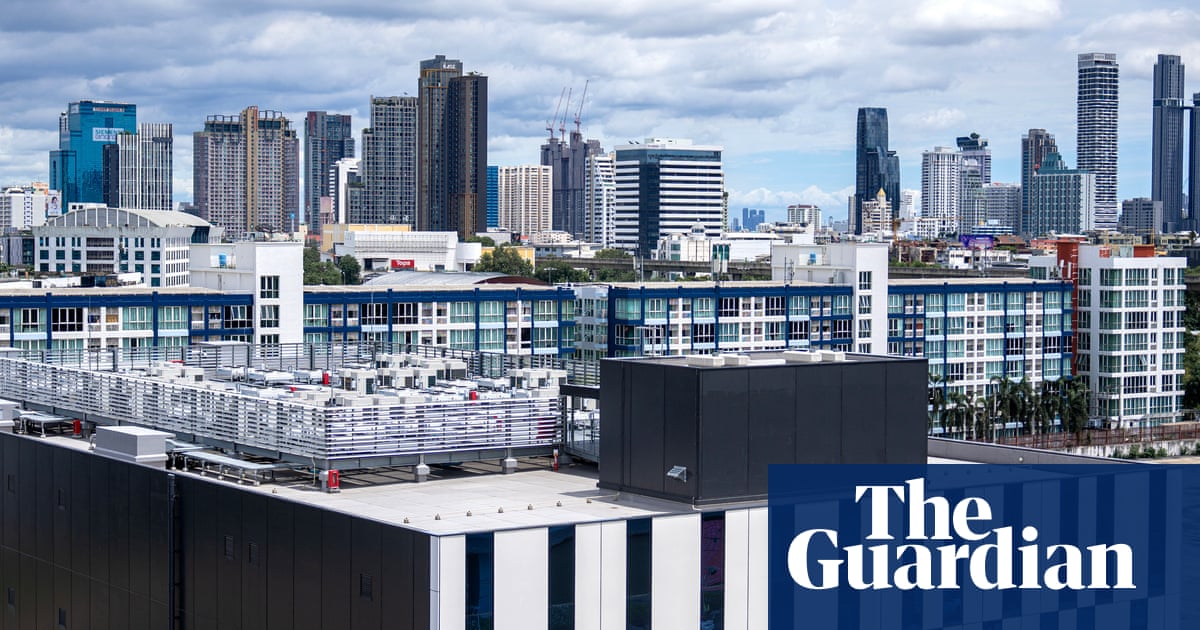
I n early 2026, Thailand’s datacentre industry was on a roll. The country’s board of investment had recently announced approval of datacentre projects from Tiktok, a UAE-based Skyline datacentre and Singapore’s Bridge datacentres, totalling a planned investment of $27bn. As the year has passed, however, what once seemed like a new industrial juggernaut has ground to a halt.
Thailand paused construction on 49 projects and approval decisions on 117 more in September 2026, amidst growing concern about the lack of sufficient details for regulation and monitoring. It is not alone in reconsidering datacentre projects. In neighbouring Indonesia, the governor of the country’s most populous province of West Java halted construction on a datacentre due to lack of permits and an incomplete environmental assessment process.
With the global rise of AI usage driving an increased demand for datacentres, south-east Asia has emerged as a surprise centre of growth in the Asia Pacific region. While China has the largest operational datacentre capacity in the region, a 2026 report by real estate firm Cushman and Wakefield shows that south-east Asia has the largest share of under-construction datacentre capacity in Asia Pacific, about 50% of the total. Malaysia and Thailand comprise a large portion of that capacity.
A general view of the construction site of GSA Data Center 02, a multi-facility hyperscale project jointly developed by Gulf Development, the Advanced Info Service and Singtel Group, in Chonburi, Thailand, on 23 October 2026. Photograph: Matt Hunt/Anadolu/Getty Images Through the 2010s, Singapore was south-east Asia’s leading datacentre hub, with companies like Alibaba and Facebook opening facilities there. However, the city-state implemented a moratorium on new datacentres from 2019 to 2022 because they were “intensive users of water and electricity”, as described in a press release from the Ministry of Energy, Trade and Industry.
Since then, approval has been selective amidst land constraints and sustainability requirements, with just 95MW of operational capacity added between 2023 and 2026, per Cushman and Wakefield . With the advent of LLMs and rise in usage of AI, associated datacentre demand has surged in the last half decade, and desperate companies looked beyond Singapore to build datacentres. Malaysia has been a major beneficiary, with operational capacity in the southern state of Johor growing more than tenfold from 94MW in 2023 to 1110MW in 2026, with 3088MW additional under construction or planned.
Johor has become the largest datacentre hub in south-east Asia, attracting $40bn of datacentre investment as of 2026, according to Menteri Besar Onn Hafiz Ghazi, the head of the state government. Key operators include Microsoft, which announced a $2.2bn investment for cloud and AI infrastructure across Kuala Lumpur and Johor in 2024, and Australian datacentre company AirTrunk, which said it plans to invest $3bn to double its datacentres in Johor from two to four. Other countries in south-east Asia are catching up.
Indonesia has a datacentre development pipeline of 1699MW in greater Jakarta, and is developing the island of Batam as a secondary hub . Microsoft is building five datacentres as part of a$1.7bn investment in the country, and Singapore-based datacentre operators Princeton Digital Group and Digital Edge are also expanding. In Thailand, Bangkok’s development pipeline stands at 2084MW, while secondary markets like Manila and Ho Chi Minh City are ramping up operations, based on Cushman and Wakefield’s analysis.
While the rush to build more datacentres is attracting big investments across the region, it is putting a strain on each country’s resources. Energy consultancy Wood Mackenzie estimates that datacentres in Johor already account for 24% of the state’s total power consumption today, which could grow to 40% by 2035. “The rapid growth of datacentre developments in Johor has the potential to create localized grid connection bottlenecks and increase the need for transmission network upgrades as well as new power supply capacity,” says Alvin Tan, research analyst at Wood Mackenzie.
The DayOne Data Centers Ltd campus and electricity supply infrastructure in the Kempas Tech Park, Johor, Malaysia, on 27 October 2026. Photograph: Samsul Said/Bloomberg/Getty Thailand’s energy minister, Akanat Promphan, has said that datacentres require large amounts of power generated from expensive imported gas, and called for a new electricity user category with higher tariffs to reflect the demand. Datacentres’ water-guzzling tendencies are also a major cause of concern for officials in the region.
Johor is prone to droughts, and the current operational datacentres are estimated to need about 675m cubic meters of water per day. In Indonesia, a report by research firm Tenggara Strategics shows that many datacentres are water-cooled and situated in hot and humid lowland environments, resulting in elevated water consumption in comparison to facilities in more favourable temperatures. In Thailand, datacentre projects in the country’s Eastern Economic Corridor have residents concerned about the pressure on their already depleted water reservoirs.
“The Khlong Luang Reservoir in Chonburi (in eastern Thailand) is a primary flashpoint,” says Somnuck Jongmeewasin, research director of research and advocacy group EEC Watch. “Despite the reservoir being shallow and under strain, authorities are piping its water to industrial estates,” he adds. skip past newsletter promotion after newsletter promotion Local communities are waking up to the changes. In February, Johor saw its first public protest against datacentre construction , with demonstrators picketing a project by China’s ZData Technologies.
Protesters expressed concern about the dust pollution caused by construction of the site near a residential location and the potential impact on water supply. “While datacentres may create substantial investment and construction activity, they generally generate fewer long-term jobs than many other industries requiring comparable amounts of land, electricity and water,” says Jie-Sheng Tan-Soo, an assistant professor at Singapore’s Lee Kuan Yew School of Public Policy. “Communities may therefore reasonably ask whether they are receiving a proportionate share of the benefits while bearing the environmental and infrastructure costs.” South-east Asia’s datacentre operators claim they are working toward making their facilities more resource efficient.
Bridge datacentres, among Malaysia’s top datacentre operators , built a water reclamation plant and pipe network in Johor to cool its upcoming datacentre, expected to come online next year, while AirTrunk, among the largest datacentre platforms in Asia-Pacific, announced a partnership with sewage treatment operator Johor Special Water in April to recycle unused wastewater for the operational needs of its data centres. An AirTrunk representative said that its “campuses are designed to operate significantly more efficiently than conventional datacentres and incorporate advanced technologies to optimise energy performance,” but did not respond to detailed queries regarding data on efficiency and energy optimization. Sustainability challenges remain.
Microsoft has said that it is looking at south-east Asian clean energy projects to fuel its datacentres, but its published data on Power Usage Effectiveness (PUE), an industry metric measuring the energy efficiency of a datacentre, shows that its Asia-Pacific facilities are the least energy efficient globally . Resource pressures have forced countries to become more circumspect about approving new datacentres. After Singapore’s moratorium ended, approval for new datacentres in the country has been strictly tied to a number of factors including power efficiency and carbon emissions.
Malaysia has established a datacentre taskforce to review new projects with an eye on energy and water security, and Johor announced that it would no longer approve Tier 1 and Tier 2 datacentres, which used up to 50m litres of water per day, equivalent to the daily drinking water needs of 25 million people. Thailand announced an approval framework for new datacentre projects that considers energy and water use, along with power guarantee requirements and higher tariffs for datacentre operators. To promote resource efficiency by datacentres, Tan-Soo advocates for integrated policy frameworks from national governments that have datacentre operators face the full social opportunity cost of the resources they consume.
“South-east Asia is increasingly aware but only partially prepared,” he says, and preparedness for environmental impacts needs to keep pace with the speed of investment.
Source: The Guardian